Art as ministry: An interview with artist and student Shantel Miller
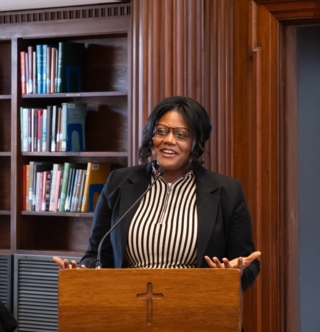
Shantel Miller speaking at the opening reception for her exhibition A Legacy Unfolding / photo by Moriah Felder
A new exhibition in the Divinity School’s Sarah Smith Gallery showcases paintings and photographs by Shantel Miller ’27 M.Div., all depicting life at her church in Ontario, Canada—Legacy Christian Worship Centre. Ms. Miller matriculated at YDS in 2024 having already earned an M.F.A. in painting from Boston University, and with a resume full of prestigious exhibitions, fellowships, and residencies at museums including MASS MoCA, NADA Miami, and Future Fair (New York).
YDS Communications interviewed Ms. Miller to learn more about her exhibition.
Something about your congregation in Ontario touched you and motivated you to create art. Tell us more about your church. What moved you to tell its story through paintings and photographs?
Growing up in a faith tradition that discerns visions and dreams as the voice of God heavily influenced how I perceive and make sense of reality through art. Early in my spiritual journey, this emphasis on sight and visual communication as a window of truth and understanding deepened my relationship with reading scripture, particularly with texts that created vivid images in my mind. This would later become an essential part of my walk with God, and a gift expressed in my artwork. At Legacy, there is emphasis on emotional experiences such as speaking in tongues, raised voices, emphatic prayer, and embodied worship as evidence of the Holy Spirit’s presence in the congregation. I chose photography as a medium to capture the immediacy and range of emotions that often take place during a service. Coming from a faith tradition steeped in Afro-Caribbean Pentecostalism, it was not until I ventured beyond the church walls that I learned Legacy worships on the fringes of North American mainstream church culture and liturgy.
The works in this exhibit are about one church—your church—but it’s clear that the story you’re telling applies more widely. What can exhibition viewers glean that is relevant to their own faith communities and worship experiences? What does your exhibition show about what church can, and should be, when it is at its best?
My hope is that viewers can witness and share a genuine connection with the same spirit present during the time the paintings were made and the photos were taken. In my creative process, I typically invoke prayer as a guiding force to lead my hands, heart, and mind while making the work serve a purpose beyond what I can see. I could not have imagined the work leading me to YDS during the time of its conception. It’s been particularly meaningful for me to exhibit this work at an ecumenical school where there are a diverse array of beliefs that share and depart from the Christian faith. It is my hope that this audience would recognize the symbolic gestures of ritual as an efficacious marrying of image and text to mediate experience with the divine.

Shantel Miller’s painting Church on Fire: “What causes one to flee or return to the church?”
Your exhibition ran through the duration of Black History Month, which is celebrated in February in Canada just as it is in the United States. Regardless of which country we’re talking about, what is your take on the role of church in Black history and Black life?
The role of the church has been and continues to be a source of violence and salvation throughout Black history until today. I attempt to grapple with this tension in the piece Church on Fire, in which Black women are depicted running to and from a church on fire. In this painting, I wanted to explore the tension in these conflicting realities through the symbol of fire as both immediate danger and the consuming presence of the Holy Spirit. A question that guided me through the making of this work was: what causes one to flee or return to the church? In exploring these promptings, the painting speaks to the themes of fugitivity, terror, and wayward hope as discussed in Dr. Turman’s Black Womanist Ethics: Black Feminist Theory class last semester. Editor’s Note: Eboni Marshall Turman is Associate Professor of Theology and African American Religion at YDS.
The title of your exhibition is A Legacy Unfolding. What is that legacy?
I see this series as a “legacy unfolding” because it is the first iteration of what I hope to make a lifelong ministry that involves me embedding myself in faith communities to learn about the unique ways the gospel is being expressed today through visual storytelling. I have great hope that the work will function as an educational tool to situate marginalized church history in visual culture over time.

Shantel Miller’s painting Breakthrough
In the painting Breakthrough, we see a graphic element combined with realistic depictions of congregation members. The effect is striking. Tell us about that choice and the effect you were going for.
The process of making this piece went through a number of iterations, particularly when it came to the color of the figures’ garments. Initially, I considered depicting the central figure in purple or red to signify royalty or the blood of Christ. However, I thought it would create a power dynamic that I think didn’t best communicate what I wanted to say. I opted to paint all the figures in white to illustrate the idea that whether we are in the position of seeking or receiving prayer, we are all able to receive and in need of grace. The collective marker of being clothed in white represents the concept of the body redeemed by Christ. The blue shards piercing the top of the painting represent the outpouring of God’s love and mercy breaking through like an expansive sky, making itself known in the deep blues.
Part of your exhibition consists of paintings, and another part consists of your photography. How do these two mediums complement one another and bring to light different aspects of the story you’re telling?
As previously mentioned, growing up in Afro-Caribbean Pentecostalism has deeply informed who I am as an artist. Since I was a young girl, I have grown accustomed to being sensitive to recognizing and connecting with the spirit of humanity, especially through emotions.
In these paintings, I wanted to push boundaries of representation and use color as a tool that can emote a state of being. At times color is used metaphorically to bring seemingly unrelated or abstract ideas together in the pictorial space. Working in this way creates complexity and ambiguity and offers multiple interpretations of meaning. I use color and light to provoke emotional tonality in the subject matter. The choice of color can suggest the temperature or a specific mood, as well as provide a structure within the composition. In my painted spaces, color plays an integral role in leading the viewer through the implied narrative and performs as the subject’s interior space.
In my process I typically work with a photo as a reference, and through the act of painting the image shifts through my color choices. As a result, the color tends to either forefront the figure in ways that the photograph has not, or it brings the viewer into heightened sense of the figure’s reality.

Shantel Miller’s painting Hell in Paradise
Color is a really powerful tool that enhances the interpretation of the figures in their realities and can bring the viewer into an alternate state. I’m drawn to using color to create a sense of balance, harmony, or tension that can point towards a broader context beyond the frame. In my paintings, I want the figures to appear alive as if inhabiting space. In the painting called Hell in Paradise, there’s a duality between the interior with silhouetted tropical landscape and the exterior which holds this undeniable red. There is a sense of both calmness and unease as the figure sits and waits patiently for things to unfold.
You had an M.F.A. before enrolling at YDS and you were well on your way in your art career. Why did you decide to go to divinity school? Why YDS?
Long story short, I had a dream that I was supposed to come here. That was in 2019, when I didn’t even know the school existed! Fast forward to 2023 after I moved back to Canada from BU. The dream came back to me, and God said now is the time. With much hesitation, I applied to the M.A.R. Visual Arts concentration program at YDS under the impression that I would be deepening theological knowledge towards the extension of my art practice. Little did I know God would be reorienting me towards working in the church professionally. Now that I have switched to the M.Div. degree, I feel more aligned in who I am as a person, and I am becoming more equipped to do the work God has been leading me to: creating spaces of healing and revelation through integration of theology and visual art.